Dorne's independence
Fire & BloodDorne’s independence was the enduring limit of Aegon Targaryen’s conquest: his armies and dragons could bring much of Westeros under his rule, but they could not compel the Dornish to submit. The First Dornish War ended not with a surrender or decisive battlefield victory, but with an agreement whose terms and catalyst remained partly obscure. Dorne’s continued resistance also exposed the political and material costs of trying to turn conquest into lasting rule.
Origins and the limits of conquest
The dates of the Conquest do not describe a single, clearly bounded campaign. Aegon’s Landing and his coronation in Oldtown were more than two years apart, and even after his anointing, Dorne remained unsubdued. Attempts to bring it into the realm continued through Aegon’s reign and into the reigns of his sons, making any precise end date for the Wars of Conquest impossible to establish. Much of the fighting that established Aegon’s power therefore took place before the calendar’s starting point, while Dorne’s unresolved status outlasted it.
After the submission of the Three Sisters and the Iron Islands, the realm south of the Wall was under Aegon’s authority with one exception: Dorne. He first tried negotiation, sending high lords, maesters, and septons to Sunspear to persuade Princess Meria Martell to join her realm to his. Talks continued for much of a year without agreement. When Rhaenys Targaryen later returned to Dorne, the campaign shifted from persuasion to force, and the conflict is generally dated from 4 AC.
Resistance and the costs of invasion
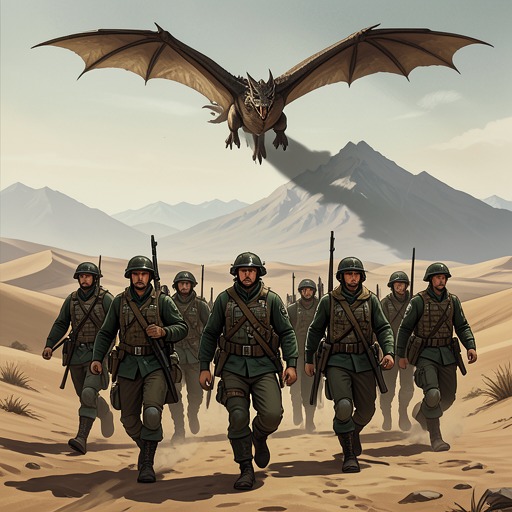
The invasion displayed the disparity between the Crown’s forces and the methods by which the Dornish avoided defeat. Aegon marched through the Prince’s Pass with an army of thirty thousand, supported by nearly two thousand mounted knights and three hundred lords and bannermen. Orys Baratheon led a thousand picked knights up the Boneway. The scale of the force suggested that the Dornish might be overwhelmed in open battle, but they did not offer one.
Instead, the Dornish withdrew, burned crops, poisoned wells, abandoned watchtowers in the Red Mountains, and left a barrier of rotting sheep carcasses in the high passes. The invaders emerged from the Prince’s Pass short of food and fodder. Aegon divided his forces, sending Harlan Tyrell toward Hellholt while he turned east to besiege Skyreach. The timing offered little relief: although the campaigners expected autumn to moderate the desert heat and make water more plentiful, the sun remained relentless. Poisoned waterholes and oases killed horses and riders as Harlan Tyrell advanced; by the time he reached Hellholt, the stronghold had been abandoned. His force lost a quarter of its men and almost all its horses.
Orys Baratheon’s route through the Boneway brought a different kind of disaster. The narrow, twisting passes and steps cut into the steep road impeded his horses, while unseen defenders sent boulders down from above. At the crossing of the river Wyl, archers attacked as the column crossed a bridge; a rockfall then blocked the retreat. The trapped stormlanders were defeated, and Orys was captured with a dozen other lords considered valuable for ransom. Aegon, by contrast, took Skyreach by storm and won Yronwood after a brief siege. These gains did not settle the conflict: capturing castles and defeating individual forces did not produce Dorne’s submission.
Peace without submission
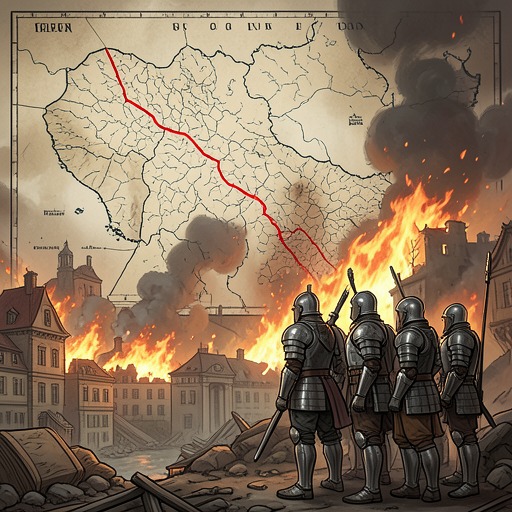
By the time peace was proposed, Aegon faced pressure from several directions. His council warned that accepting peace without submission could look like weakness and encourage rebellions. The Reach, the stormlands, and the marches had suffered heavily, while fear of attacks in King’s Landing required Dornish visitors to travel under strong escort. Aegon was close to continuing the war when Princess Deria presented him with a sealed letter from her father, Prince Nymor Martell.
Aegon read the letter in open court, burned it, and said nothing about its contents. That night he flew across Blackwater Bay to Dragonstone on Balerion. When he returned the next morning, he accepted Nymor’s terms; a treaty of eternal peace followed soon afterward. The sequence is known, but the letter’s substance is not. It may have been an appeal from one father to another, a record of the war’s dead, or a threat against Aegon’s young heir, Aenys. These remain competing later explanations, not established facts. The account also records a more extraordinary claim that the letter contained sorcery, but gives no certainty to it. The concealed message thus marks a decisive change in policy while leaving the reason for that change unresolved.
Legacy and continuing independence
The First Dornish War, dated 4–13 AC, ended without Dorne being incorporated into Aegon’s realm. In the kingdoms north of the Red Mountains, the outcome was often recast as dishonorable: some writers used Dornish courage as a term of mockery, treating withdrawal, deception, and evasion as cowardice. Yet the campaign’s record makes plain that these methods frustrated a far larger invading force, exhausted its supplies, and inflicted serious losses without offering the kind of battle its commanders expected to win.
The contrast between the mainland’s contempt and Dorne’s survival is central to the legacy of its independence. Survivors and the relatives of the dead promised that there would be a future reckoning, but vengeance belonged to another generation. Aegon remained on the Iron Throne for many more years, yet the Dornish conflict was his last war. During the later regency of Jaehaerys, Dornish raiders again ventured into the marches and even troubled the stormlands; rumors also spoke of another Vulture King in the Red Mountains. The Crown’s response was constrained by claims that the king’s brothers lacked the men and money to root out the threat. Dorne’s independence was therefore not merely the endpoint of one campaign: it remained a practical limit on royal power, visible in the continuing danger along the borders and in the repeated cost of trying to overcome it.